Expert Education

The Granite Expo Stone Guide
Everything you need to know
before you choose.

From granite vs. quartzite to sealing schedules and edge profiles. This is the guide we wish every client had before walking into any stone showroom.

Stone Type

Quartzite

A metamorphic rock formed from sandstone under extreme heat and pressure, delivering marble-like beauty with superior hardness and durability.
Maintenance Level: Low
Best Applications
Kitchen Countertops Waterfall Islands Bathroom Vanities Feature Walls Shower Surrounds Outdoor Kitchens
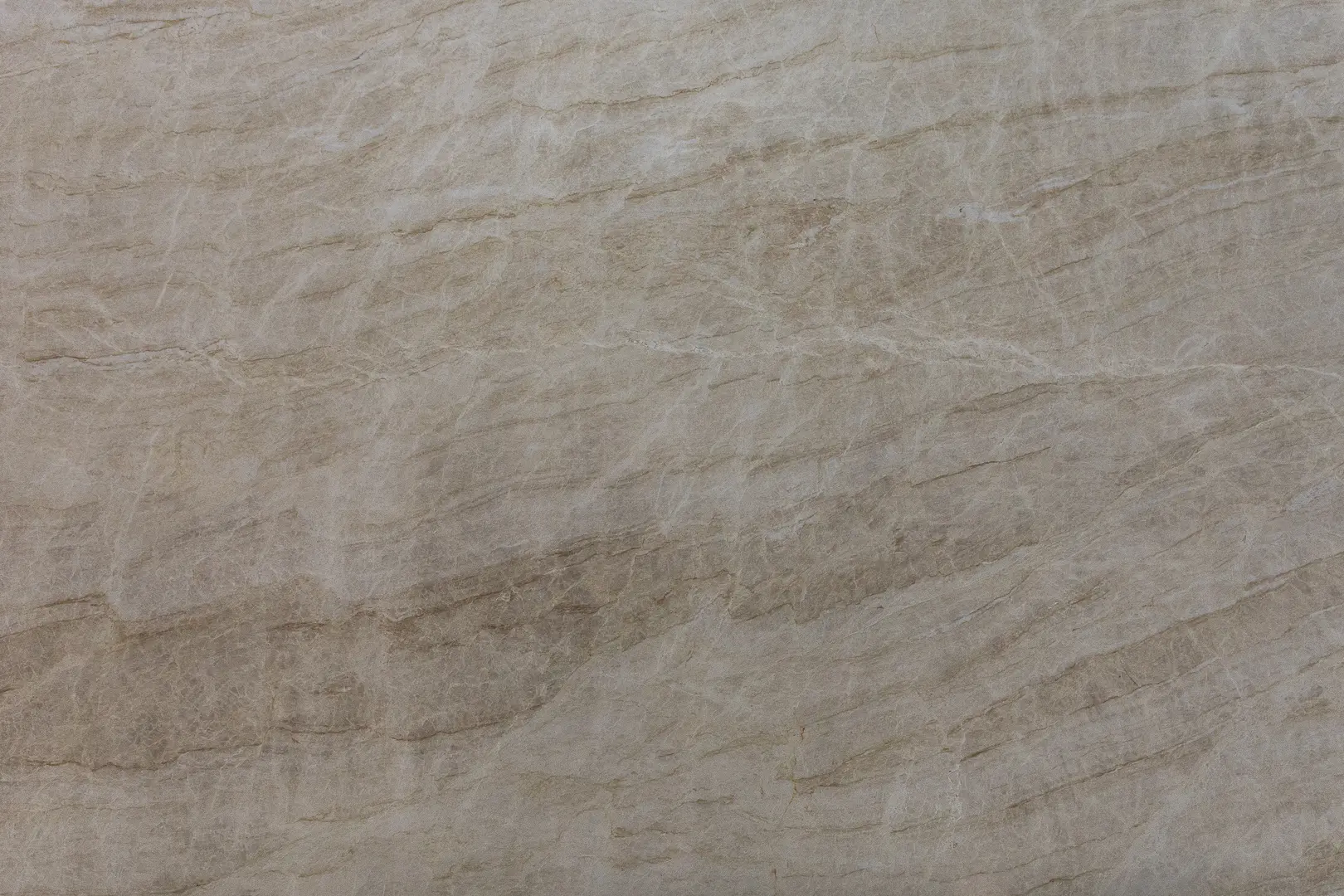
Premium Taj Mahal Polished quartzite — soft beige and ivory tones with gold veining, example of quartzite beauty

Quartzite begins as sandstone deep within the Earth's crust. Subjected to intense heat (above 700°C) and pressure over millions of years, the sandstone recrystallizes into quartzite, one of the hardest naturally occurring stones, scoring 7 on the Mohs hardness scale. This puts it significantly harder than marble (3–4) and comparable to granite (6–7).

The beauty of quartzite lies in its geology: the original sandstone layering creates sweeping, directional veining patterns that flow across the surface. In translucent varieties (like our Crystallo family), the silica crystals allow light to pass through, creating a glowing, luminous effect that is unique in the natural stone world.

"Is quartzite the same as marble?" No. Despite similar appearances, quartzite is a completely different geological material. Quartzite is significantly harder, resists etching from acids, and performs better in kitchen environments than marble.

What is quartzite good for? Is it better than marble for kitchen countertops? +
Quartzite is excellent for kitchen countertops precisely because it delivers the marble aesthetic without marble's vulnerability. Marble etches easily when it contacts acidic foods (lemon juice, wine, tomato sauce). Quartzite is largely etch-resistant, making it far more practical for daily kitchen use. For clients who love the marble look but want real-world durability, quartzite is the answer.
Does quartzite need to be sealed? +
Yes. Despite being denser than marble, quartzite is still porous and should be sealed upon installation. Annual resealing is recommended for kitchen surfaces. Use a penetrating impregnator sealer designed for natural stone. Test: drop water on the surface. If it absorbs within 4–5 minutes rather than beading, reseal.
What finishes are available in quartzite? +
Quartzite is available in three primary finishes: Polished: high-gloss, reflective surface that emphasizes color and veining depth. Honed: matte, smooth surface with a soft, modern feel. Slightly more prone to showing fingerprints. Leathered: textured, brushed surface that enhances the stone's natural character and is very practical for busy households (hides fingerprints, water spots). Our showroom carries all three.
Stone Type

Granite

An igneous rock formed by cooled magma, one of the hardest and most heat-resistant natural stones available, with dramatic crystalline patterns.
Maintenance Level: Low
Best Applications
Kitchen Countertops Outdoor Kitchens Flooring Feature Walls Commercial Spaces
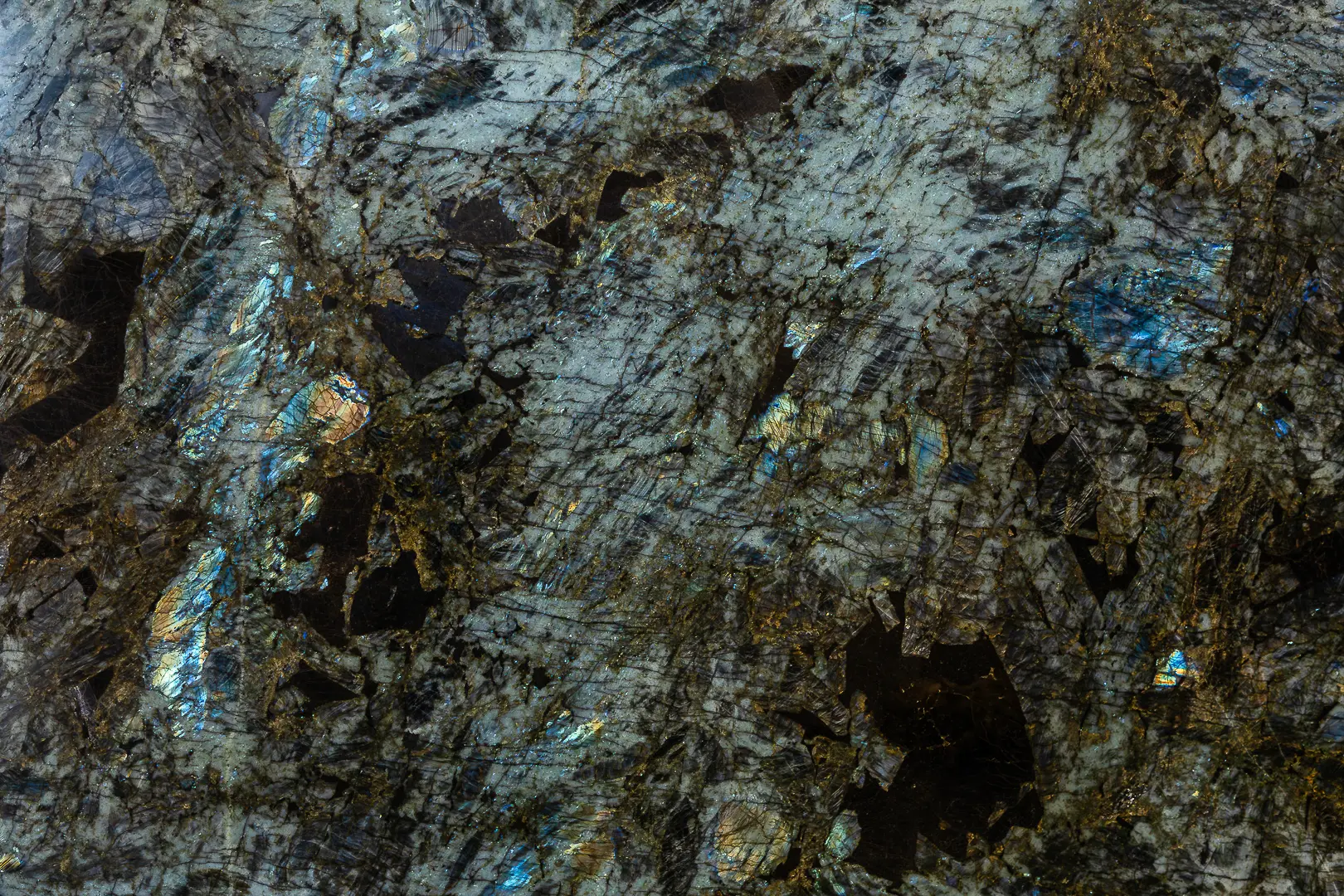
Blue Bahia exotic granite — vibrant ocean blue crystalline pattern from Brazil, example of granite at its most dramatic

Granite forms when magma cools slowly beneath the Earth's surface, allowing large mineral crystals, primarily quartz, feldspar, and mica, to grow. The result is a granular, crystalline pattern with specks and clusters of color. Granite scores 6–7 on the Mohs scale, making it one of the hardest natural stones used in residential applications.

Our exotic granite collection includes stones that go far beyond the traditional speckled look. Blue Bahia, with its vivid cobalt blue crystalline matrix, and Sodalite, with rich blue and gold interplay, represent granite as true geological art. Leathered granites like Titanium and Negresco offer a sophisticated matte surface that is exceptionally practical.

How is granite different from quartzite? +
Granite is an igneous rock (formed from cooled magma) with a speckled, granular appearance. Quartzite is a metamorphic rock (transformed sandstone) with flowing, marble-like veining. Both are very hard. Granite tends to be more uniform in pattern; quartzite has more dramatic, sweeping movement. Granite is generally considered slightly more resistant to heat and less porous than quartzite.
Is granite good for outdoor use in Las Vegas? +
Granite is an excellent choice for outdoor kitchens and surfaces in Las Vegas. It is highly resistant to UV fading, temperature extremes, and moisture. Its hardness makes it scratch-resistant even in high-traffic outdoor applications. Honed or leathered finishes are preferred outdoors as they provide better grip when wet and show less wear from exposure.
What makes exotic granite different from standard granite? +
Exotic granite refers to rare varieties sourced from specific geological formations that produce unusual coloration or pattern. Our Blue Bahia (vibrant cobalt blue), Sodalite (ocean blue with gold), and Lemurian (rainbow labradorescence) are found in limited geological deposits. These stones command premium pricing because of their rarity, and because no other material can replicate their appearance. We source them directly from Brazilian quarries.
Stone Type

Marble

A metamorphic limestone beloved for its classic elegance. It is the definitive luxury stone, though it requires more care than quartzite or granite.
Maintenance Level: High
Best Applications
Bathroom Vanities Fireplace Surrounds Feature Walls Entryway Floors Low-Traffic Surfaces
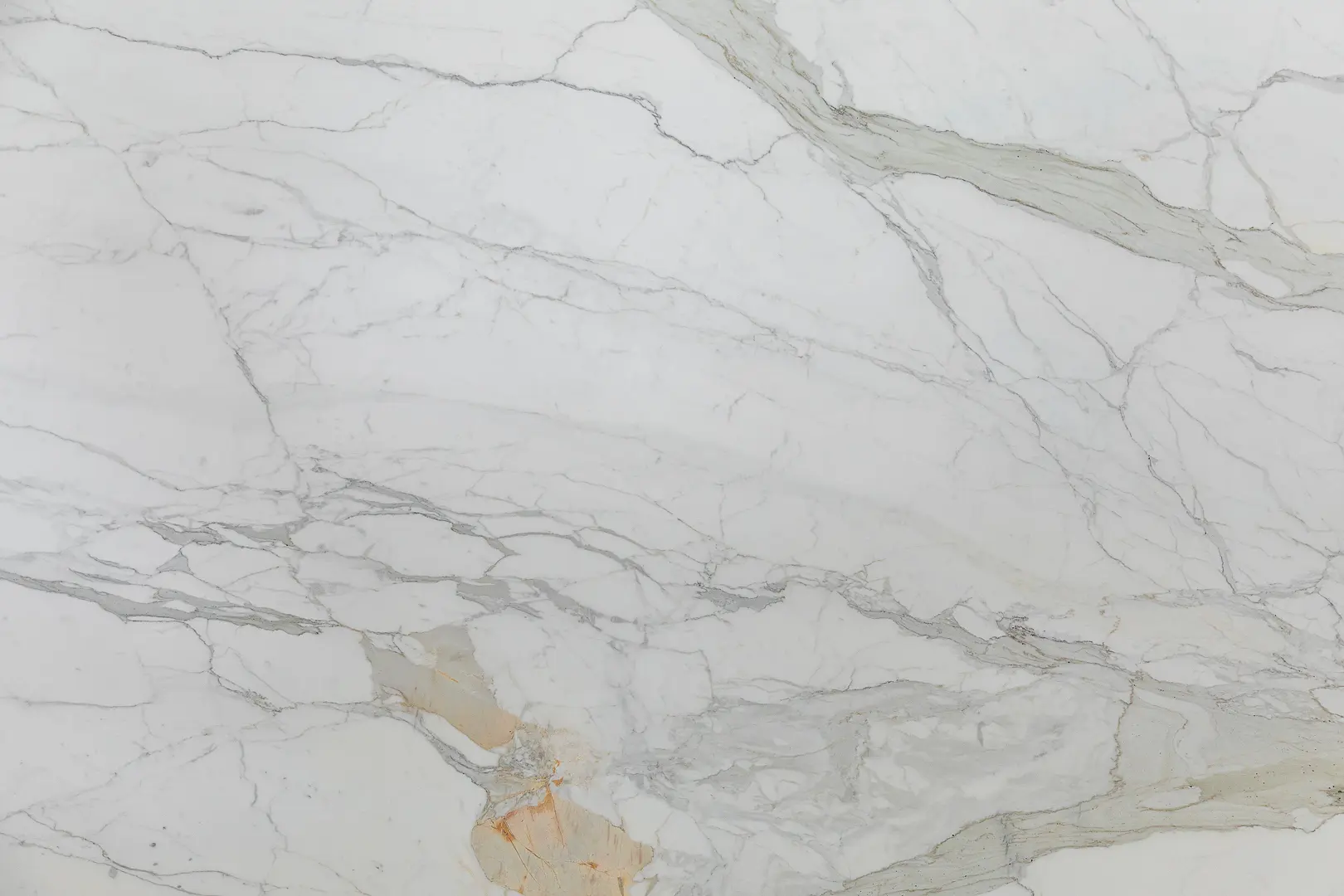
Italian Calacatta Gold marble — honed finish with golden veining on creamy white background, classic Italian luxury

Marble is metamorphic limestone, which is limestone subjected to heat and pressure that recrystallizes the calcium carbonate into the shimmering, veined material we recognize. Its Mohs hardness of 3–4 makes it softer than granite or quartzite, which is why it etches when it contacts acidic substances. However, its visual beauty is unmatched in the natural world.

We carry Italian and Brazilian marble, including rare historical Italian varieties. Our Calacatta Gold (Italy) and Ocean Red (rare Italian historical marble with deep crimson and green veining) represent the extraordinary end of this category. For clients who understand marble's nature and want to embrace its authentic character, including the patina it develops over time. There is no more beautiful stone.

Can I use marble in my kitchen? +
Yes, but with clear expectations. Marble etches when it contacts acidic substances (lemon, wine, vinegar, tomato), leaving dull marks. These are not stains. They are chemical reactions with the calcite. Some clients love the patina this creates over time (as seen in antique European kitchens). Others find it frustrating. Our honest recommendation: if you want the marble look in a kitchen without the maintenance trade-offs, consider dolomite or quartzite. If you love authentic marble and accept its living, changing nature, it is magnificent.
What is the difference between honed and polished marble? +
Polished marble has a high-gloss, reflective surface that emphasizes depth and color. It shows etching more clearly as the glossy surface is disrupted. Honed marble has a matte, smooth surface, showing etching less obviously (no gloss to lose), but it does absorb liquids more readily and requires more frequent sealing. Many design professionals prefer honed marble in kitchens for this reason.
Stone Type

Dolomite

A sedimentary rock composed of calcium magnesium carbonate, harder than marble, with equally dramatic veining. The practical choice for clients who want marble drama with better performance.
Maintenance Level: Medium
Best Applications
Kitchen Countertops Bathroom Vanities Waterfall Islands Feature Walls Shower Surrounds
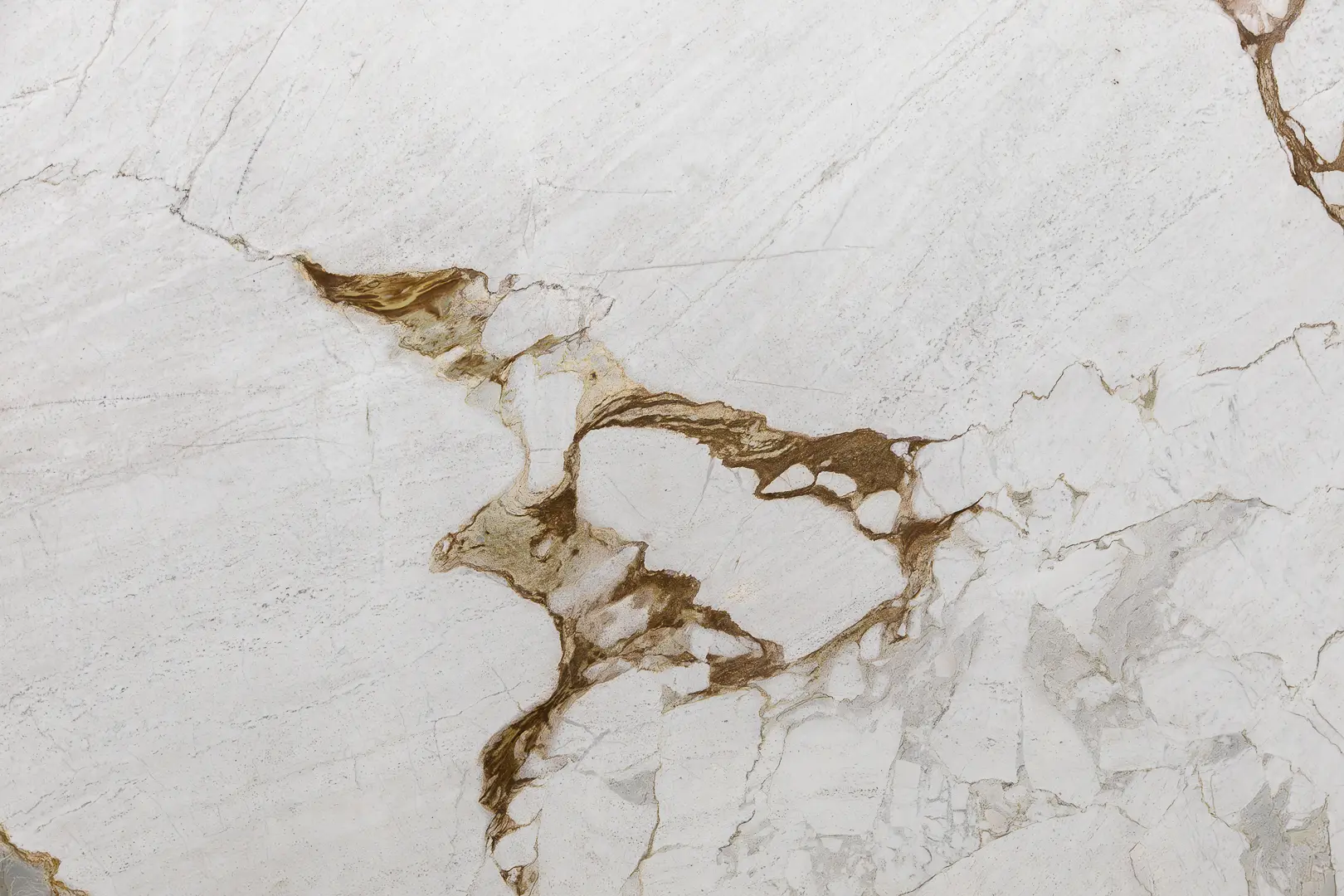
Calacatta Super White dolomite slab — leathered finish with dramatic bold veining, marble-like beauty with better durability

Dolomite sits at approximately 3.5–4 on the Mohs scale, slightly harder than marble but softer than quartzite. It is composed of calcium magnesium carbonate rather than pure calcium carbonate (marble), giving it somewhat better acid resistance. However, it is not etch-proof and should still be sealed and maintained with care.

What makes dolomite extraordinary is its visual character. Varieties like our Calacatta Super White, Michel Angelo, and Crystalita Blue display the bold, sweeping veining that clients associate with the most dramatic Italian marble, but with better durability and, in many cases, more unique movement. It is consistently our most sought-after category.

Is dolomite better than marble for kitchen countertops? +
Dolomite performs slightly better than marble in kitchen settings due to its marginally harder composition. It is more resistant to etching (but not etch-proof). With proper sealing and reasonable care, avoiding prolonged contact with acids — dolomite works well in active kitchens. For clients who love the marble look but want a practical improvement, dolomite is an excellent choice. For the most demanding kitchen use, we still recommend quartzite as the most durable option.
What does "Super White" mean in dolomite? +
Super White is a trade name for a specific variety of dolomite quarried in Brazil, characterized by its brilliant white base with bold gray veining, similar in appearance to Italian Calacatta marble. Despite the "granite" label sometimes applied by retailers, Super White is correctly classified as dolomite. Our Calacatta Super White is a premium example of this material, shown in leathered finish with exceptional veining drama.
Stone Type

Semi-Precious

Hand-assembled panels of agate, quartz, and mosaic crystal. Not traditional countertop stone, but extraordinary art that glows magnificently when backlit.

Maintenance Level: Medium
Best Applications
Backlit Feature Walls Bar Tops Luxury Vanities Illuminated Countertops Statement Furniture
Blue Agate semi-precious stone panel — icy blue and indigo layers that glow magnificently when backlit

Our semi-precious stone collection consists of hand-assembled panels crafted from agate slices, crystal quartz pieces, and mosaic arrangements. These are not conventional countertop materials. They are gemstone-quality panels used to create feature walls, illuminated bar fronts, luxury vanities, and high-end statement surfaces.

When backlit, these panels transform entirely. The translucent agate and quartz allow LED light to pass through, creating a glowing effect that must be seen in person to be believed. Our collection includes Black Chameleon Agate, Blue Agate, Crystal Quartz Mosaic, Rose Quartz Mosaic, and Wild Agate.

Can semi-precious stone be used as a kitchen countertop? +
Semi-precious agate and quartz panels are not recommended for high-traffic kitchen countertops. Agate scores 6.5–7 on the Mohs scale but the hand-assembled mosaic structure (with epoxy grouting) makes it vulnerable to impact and heat. These materials perform best as low-contact statement surfaces: bar tops, feature walls, vanity tops, and decorative counters where they won't face daily cooking wear. The visual impact is extraordinary when used appropriately.
How does backlighting work with semi-precious panels? +
Agate and quartz are translucent minerals, meaning they allow light to pass through. When installed over LED strip lighting (typically warm white or color-adjustable), the light passes through the stone and illuminates the natural banding and crystal structure from within. The effect is stunning and can be dramatically different from the same panel seen without backlighting. We recommend discussing backlighting requirements with your fabricator or designer before installation.
Compare All Stone Types

Which stone is right for you?

Stone Type Hardness (Mohs) Etch Resistance Best Kitchen Use Maintenance Price Range
Quartzite 7 Excellent Yes, highly recommended Low (seal annually) $$$–$$$$
Granite 6–7 Excellent Yes, excellent choice Low (seal annually) $–$$$
Dolomite 3.5–4 Good Yes, with care Medium (seal every 3–6 mo) $$–$$$
Marble 3–4 Poor Yes, if you accept patina High (frequent sealing + care) $$–$$$$
Semi-Precious 6.5–7 (stone only) N/A Not recommended for cooking Medium (gentle cleaning) $$$$
Fabrication

Common Fabrication Questions

What edge profiles are available for stone countertops? +
Common edge profiles include: Eased (square with slightly softened corner): clean, modern. Beveled — angled cut for a softer look. Bullnose — fully rounded for a classic, soft feel. Ogee — S-curve profile for traditional elegance. Mitered: stone folded at 45° to create an ultra-thin, seamless waterfall effect. Waterfall / Straight: vertical face for a modern monolithic look. Your fabricator handles edge profiling. We recommend discussing edge choice with your designer before slab selection.
What thickness should I choose: 2CM or 3CM? +
Most of our inventory is 2CM (approximately 3/4 inch). 2CM is the standard for countertops, vanities, and most applications. 3CM (approximately 1.25 inch) is heavier and does not require plywood buildup for unsupported spans — making it preferred for thick waterfall islands and applications where the full thickness edge is part of the design. We carry select 3CM slabs. Note: 2CM slabs used for countertops typically have a plywood or composite substrate laminated underneath for support.
How are seams handled in stone countertops? +
Seams are unavoidable in most countertop installations that span longer than a single slab. Skilled fabricators use color-matched epoxy and book-matching techniques to minimize visibility. The key is slab selection: stones with consistent veining (like Taj Mahal or Bianco Laura) produce more invisible seams. Stones with dramatic, directional movement create more visible seams. This is often considered a natural characteristic rather than a flaw. Discuss seam placement with your fabricator before template.
How long does it take from purchasing a slab to installation? +
Typical timeline: Select your slab (Day 1). We hold it complimentary for one week. Once purchased, we store the slab until your fabricator is ready. Fabricator templates when cabinets are installed. Fabrication takes 7–14 business days. Installation is typically one day. Total from slab purchase to installed countertop: 2–4 weeks, depending on your fabricator's lead time. Plan for this when scheduling your kitchen or bathroom remodel.
Can I have an undermount sink with natural stone? +
Yes. Undermount sinks are the most common sink installation for natural stone countertops. The fabricator cuts the sink opening and polishes the exposed edges. This creates a seamless look and makes cleaning easy (no lip to catch debris). Farmhouse/apron sinks are also popular with natural stone. Drop-in sinks can also be used. Discuss sink specifications with your fabricator before they template.
Care & Maintenance

How to keep your stone beautiful for decades.

Sealing

  • Seal all natural stone countertops upon installation
  • Quartzite and granite: reseal annually
  • Marble and dolomite: reseal every 3–6 months
  • Test: drop water on surface. If it absorbs in, reseal
  • Use a penetrating impregnator sealer designed for natural stone
  • Apply sealer per manufacturer instructions and allow full cure time

Daily Cleaning

  • Wipe with a soft cloth and warm water after use
  • Use pH-neutral stone cleaner for deeper cleaning
  • Blot spills immediately. Do not wipe and spread
  • Avoid bleach, ammonia, and acidic cleaners (vinegar, citrus)
  • Do not use abrasive scrubbers or steel wool
  • Avoid multi-surface cleaners not rated for natural stone

Do's

  • Use cutting boards. Never cut directly on stone
  • Use trivets and hot pads under hot cookware
  • Clean up food and beverage spills immediately
  • Use coasters under glasses (especially acidic drinks)
  • Seal regularly as recommended
  • Consult a stone professional for chips or damage repair

Don'ts

  • Never use vinegar, lemon juice, or acidic products
  • Never use bleach, ammonia, or Windex on natural stone
  • Never use abrasive powders or scrubbing pads
  • Don't sit or stand on countertops. They are not load-bearing at edges
  • Don't use steam cleaners. Heat and pressure can damage sealers
  • Don't ignore chips. Small chips worsen over time without repair
Still Have Questions?

Chat with our stone advisor.

Every project is unique. If your question isn't answered here, our team is available to discuss your specific situation: stone type, finish, application, maintenance, or anything else on your mind.

Contact Our Team Browse Quartzite Collection